Deepfake Fraud Prevention for Banks Is Possible In 2026
January 21, 2026
Whenever we speak to a bank fraud executive or team leader, deepfake fraud prevention for their bank is usually at the very top, or close to the top, of their fraud defense priority list for 2026.
The “why” is obvious. In 2025, deepfakes were linked to 20% of biometric fraud attempts, a number likely to soar this year. And it reflects broader trends. Basically everyone is worried about deepfakes.
But one of the most satisfying parts of our job is being able to tell bank fraud teams: “Yes, you can prevent deepfake fraud at scale, and without damaging the user experience.”
Deepfakes can be prevented by making biometric authentication persistent and present throughout a user's entire session.
How? In this article, I'll explain why, but first, I need to give you the essentials about banking deepfake fraud prevention in 2026.
The 2026 Deepfake Bank Fraud Threat Landscape Is Deeply Serious
In 2026, banks are operating in a landscape where incidents involving deepfakes have been growing at a near-exponential rate for almost two years.
Deepfakes have been around for a while, but deepfake fraud attempts surged from an average of one per month to seven per day in 2024.
Now, early data on deepfake fraud trends indicates a deepfake threat growth rate of more than 162% during 2025, with a likely jump in deepfaked calls alone of more than 155% in the same year.
And there is no reason why this rate of growth will slow. Industry-wide, 89% of compliance professionals believe fraud is the financial crime most likely to rise because of AI.
Deepfake fraud has gotten easier to pull off for criminals and harder to stop for financial institutions. With 15 seconds of a victim’s voice, a photo from their Facebook account, and some basic knowledge of how your bank authenticates users, a realistic deepfake is possible.
Back in 2025, we explained some classic deepfake scenarios and how to stop them.
Parallel to the consumer-grade AI models many people use daily is a vast market for hacked tools with no guardrails, many of which are designed specifically to create deepfakes for criminal purposes.
Customers are worried about deepfakes, but few banks have taken serious action
With 71% of organizations stating that deepfake defense will be a top priority for their cybersecurity strategies over the next 12-18 months, there is a glimmer of hope.
However, only 37% are currently investing in deepfake defense, leaving many exposed to potential attacks.
Consumers are realising the risks too. According to Gallup, only around one in four Americans expresses a "great deal" or "quite a lot" of confidence in banks.
Yet almost all expect their bank to protect them. A 2024 survey found that 50% of consumers ranked "have better fraud detection systems" as the top action their banks could take to protect them from scams.
However, what consumers really want is not fraud detection (which lags fraud), but fraud prevention. They want to stop worrying about losing money during routine transactions.
Learn about what real people think about bank app user experiences.
To date, few banks have fully understood the reality of deepfake threats or how to prevent them.
Banks Face 4 Different Deepfake Fraud Attack Vectors In 2026
In 2026, there are four key deepfake fraud vectors that attackers use to target banks.
Although many fraud attempts are omnichannel and some even involve physical deepfakes (e.g., prosthetic fingerprints), most will use one or all of these deepfake techniques:
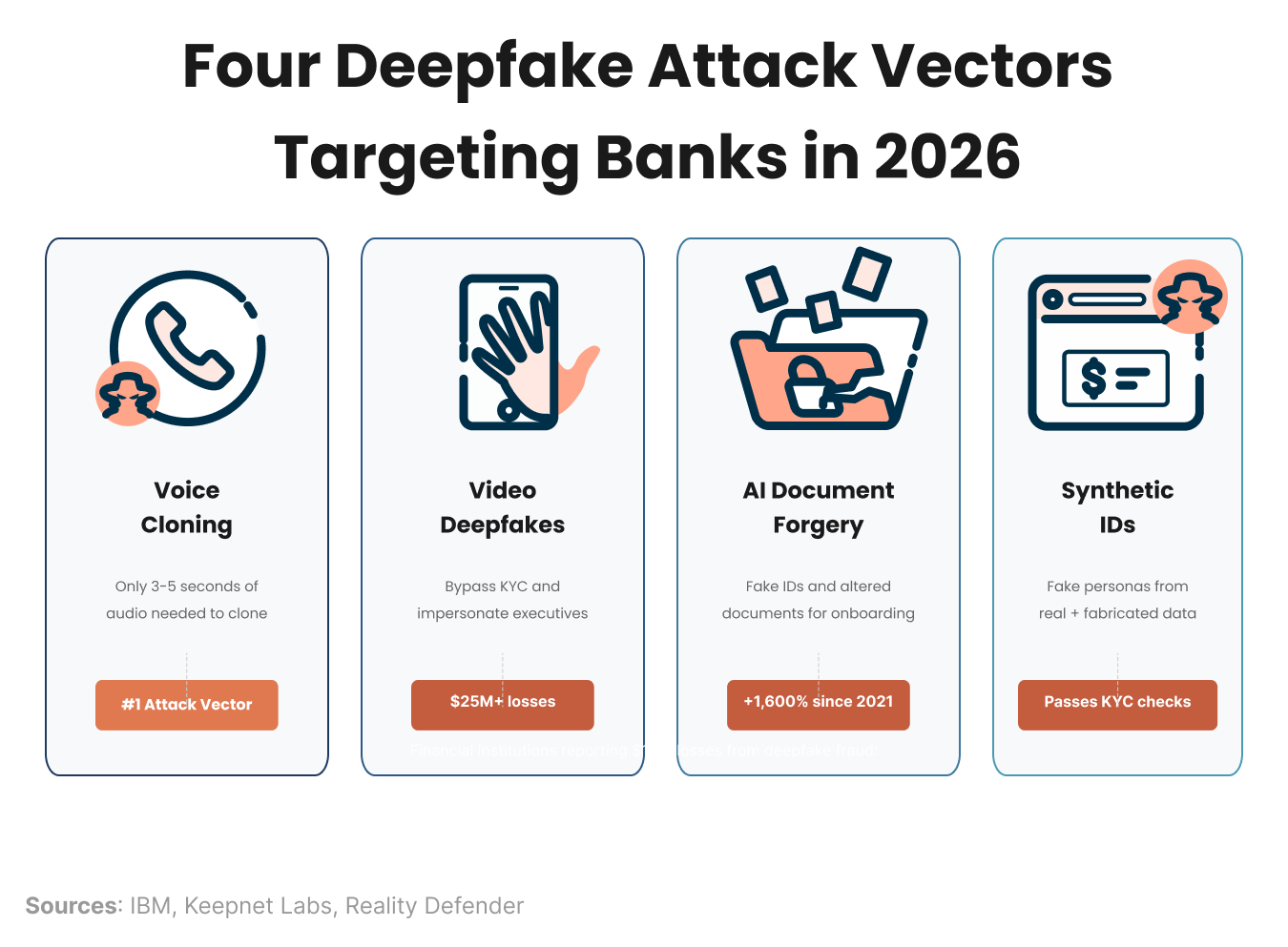
1. Voice cloning is now the top attack vector for deepfakes in general. In 2026, creating a convincing voice clone requires just three to five seconds of sample audio.
2. Video deepfakes are used both to bypass KYC checks and impersonate executives. The most notorious case was a $25 million loss after fraudsters impersonated a CFO during a video call, but smaller frauds, including account takeover and first-party fraud, are happening daily.
3. AI document forgery is up 1,600% since 2021, with fraudsters submitting AI-altered documents to open fake accounts.
4. Synthetic identities combine real and fabricated data to create entirely new personas that pass standard onboarding checks.
The financial sector will be ground zero for deepfake fraud in 2026.
Deepfake Fraud Prevention for Banks Requires a New Approach
We explain in another blog post (linked below) why traditional fraud detection tools fail against deepfakes, but the short answer is this: fraud detection is predictable and point-in-time.
Deepfake scammers can anticipate and bypass each checkpoint. Eventually, your detection system will fail. The only reliable way to stop deepfakes is to prevent them from authenticating in the first place.
Learn more about why bank fraud detection systems fail to stop deepfake.
Deepfake Fraud Prevention Works By Making the User’s Session Hostile to Deepfakes
Deepfakes often get past point-in-time checks because they only need to be convincing for a few seconds in order to clear a biometric authentication threshold (e.g., >70% that the user is real).
Once authentication happens, the malicious user is free to act as they please.
Continuous authentication closes this door that deepfakes exploit by turning the entire session into an environment where synthetic media cannot survive.
Preventing deepfake fraud for banks relies on three elements working together.
Continuous identity verification analyzes facial data throughout the interaction, not just at login, using multi-frame liveness and deepfake detection.
Intent verification links identity data with session activity to confirm that the customer is actually entering information and that it has not been manipulated by AI or malware.
A Boolean fraud decision cryptographically binds authentication with screen content to allow or block transactions in real time.
This removes probability-based fraud scores and friction-heavy step-ups.
A deepfake might fool a single checkpoint, but maintaining consistency across continuous analysis while having every action cryptographically sealed is nearly impossible.
Instead of asking, "Is this probably fraud?", the system answers definitively, "Is the authorized user performing this transaction?"
IronVest’s ActionID Prevents Deepfakes for Banks
ActionID is IronVest’s continuous authentication solution that enables true deepfake fraud prevention for banks. It works by creating a continuous biometric link between a person and their account. This link is boolean: the person is either verified, or they're not.
There is no room for deepfakes with ActionID. Our solution is designed to combat the banking scams on this list and remain resistant to deepfake technology.
ActionID is not only safer than alternative solutions on the market, but it is also legitimately easier to use for the end user. There is no need for 2FA codes, push notifications, or any other kind of in-session interruption.
Authentication is continuous and, critically for today’s banks, private.
Get a demo of IronVest today to see how your bank can roll out reliable, private, and future-proof protection against deepfakes in 2026.